




 Our Editorial Team (15 years advising on self-directed IRAs) · Fact-checked by Our Editorial Team against IRS Publication 590-A and 26 U.S.C. § 408(m). Advertising disclosure: We may earn a commission when you open an account with custodians ranked below; rankings are independent and compensation does not influence scores.
How to Convert Your IRA to Physical Gold — 4 Steps
Converting an IRA to physical gold requires four steps: (1) open a self-directed IRA with an IRS-approved custodian, (2) fund the account via direct transfer or 60-day rollover from your existing IRA or 401(k), (3) select IRS-eligible gold meeting the .995 fineness standard, and (4) direct the custodian to purchase the metals and deliver them to an IRS-approved depository. You cannot take personal possession of the gold while it remains in the IRA — doing so triggers an immediate taxable distribution and the 10% early withdrawal penalty if you are under 59½.
Open a Self-Directed IRA
Choose an IRS-approved gold IRA custodian and complete their account application. A self-directed IRA gives you the authority to hold alternative assets — including physical gold, silver, platinum, and palladium — that standard brokerage IRAs prohibit. Applications are typically approved in 1–3 business days.
Fund via Direct Transfer or Rollover
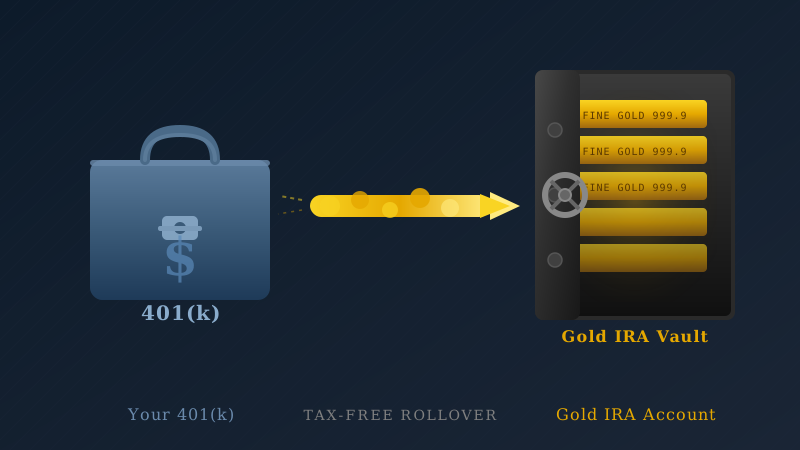
Initiate a direct custodian-to-custodian transfer from your existing IRA or former employer’s 401(k). Funds move between institutions without touching your hands, so no 20% withholding tax applies and no 60-day deadline starts. If you choose an indirect rollover (check mailed to you), you must re-deposit 100% of the gross amount within 60 days or face income taxes plus the 10% early withdrawal penalty.
Select IRS-Eligible Gold
Choose gold bullion bars or coins that meet the IRS minimum .995 fineness standard (exception: American Gold Eagles are .9167 fine but are IRS-approved by statute under 26 U.S.C. § 408(m)(3)(A)). Work with your custodian’s approved precious metals dealer to place the purchase order.
Arrange IRS-Approved Depository Storage
Your custodian directs the dealer to ship the metals directly to an IRS-approved depository — such as Delaware Depository, Brink’s, HSBC, or JPMorgan Chase. You choose between commingled storage (lower cost, metals pooled) or segregated storage (higher cost, your metals stored separately). Expect delivery within 7–14 business days of the purchase.
Direct Transfer vs. Rollover: How to Move Funds Without Taxes
A direct custodian-to-custodian transfer is the safest method — no tax withholding, no 60-day deadline, and no risk of accidental distribution. You can execute unlimited direct transfers per year. An indirect (60-day) rollover carries three risks you must manage:
| Factor | Direct Transfer | Indirect Rollover (60-day) |
|---|---|---|
| Tax withholding | None | 20% mandatory withholding from IRA custodian |
| Deadline | None | Must re-deposit within 60 calendar days |
| Frequency limit | Unlimited | Once per 12-month period per IRA (IRS Notice 2014-54) |
| Penalty if missed | N/A | Income tax + 10% early withdrawal penalty (if under 59½) |
| Recommended for | All conversions | Short-term cash needs only |
IRS Publication 590-A (Contributions to Individual Retirement Arrangements) governs transfer and rollover rules. The IRS one-rollover-per-year rule applies per IRA account, not per taxpayer — a distinction confirmed in Bobrow v. Commissioner (T.C. Memo 2014-21).
IRS Rules for Physical Gold in an IRA
Your self-directed IRA must hold gold that meets a .995 fineness minimum, sits in an IRS-approved depository, and stays out of your personal possession. The governing statute is 26 U.S.C. § 408(m), which prohibits “collectibles” in IRAs but carves out an exception for gold, silver, platinum, and palladium bullion meeting minimum fineness standards. The IRS also requires custodians to report contributions on Form 5498 and distributions on Form 1099-R each tax year.
- Minimum fineness: Gold — .995; Silver — .999; Platinum — .9995; Palladium — .9995
- Storage requirement: Metals must be held by an IRS-approved non-bank trustee or bank (IRS Rev. Proc. 92-56) — such as Delaware Depository or IDS of Texas
- No home storage: The IRS treats any IRA gold you store at home as a taxable distribution and adds a 10% early-withdrawal penalty if you are under 59½
- Required Minimum Distributions (RMDs): At age 73, you must begin taking RMDs; you may satisfy them by taking an in-kind metal distribution or selling metals for cash
- Prohibited transactions: You cannot buy metals from or sell metals to a disqualified person (yourself, your spouse, or lineal descendants) — 26 U.S.C. § 4975
IRA-Eligible Gold: Coins and Bars That Qualify
IRS-approved gold includes American Gold Eagle coins (.9167 fine, exempt by statute), Canadian Gold Maple Leaf coins (.9999 fine), Austrian Philharmonics (.9999 fine), and gold bars and rounds at .9999 purity produced by NYMEX/COMEX-accredited refiners. South African Krugerrands (.9167 fine) do not qualify because they are not bullion coins as defined by statute and do not meet the .995 fineness threshold.
| Gold Product | Fineness | IRS Status | Notes |
|---|---|---|---|
| American Gold Eagle (1 oz, 1/2 oz, 1/4 oz, 1/10 oz) | .9167 | Eligible | Statutory exemption under § 408(m)(3)(A) |
| American Gold Buffalo | .9999 | Eligible | Pure gold, meets .995 standard |
| Canadian Gold Maple Leaf | .9999 | Eligible | Widely accepted by all custodians |
| Austrian Gold Philharmonic | .9999 | Eligible | Legal tender in Austria |
| Australian Gold Kangaroo/Nugget | .9999 | Eligible | Perth Mint, annual design change |
| Gold Bars (NYMEX/COMEX-approved refiners) | .9999 | Eligible | Must be from approved refiner (e.g., PAMP Suisse, Credit Suisse) |
| South African Krugerrand | .9167 | Not Eligible | No statutory exemption; fails .995 threshold |
| Collectible/numismatic coins | Varies | Not Eligible | Treated as collectibles under § 408(m)(2) |
Gold IRA Fees: Setup, Custodian, and Storage Costs
Expect a one-time account setup fee of $50–$150, an annual custodian/administration fee of $75–$300, and storage fees of $100–$300/year depending on whether you choose commingled or segregated vaulting.
| Fee Type | Low End | High End | Notes |
|---|---|---|---|
| Account setup fee | $0 | $150 | One-time; some custodians waive for large accounts |
| Annual administration fee | $75 | $300 | Charged by custodian regardless of account size |
| Commingled storage | $100/yr | $150/yr | Metals pooled with other investors’ holdings |
| Segregated storage | $150/yr | $300/yr | Your metals stored separately; higher cost but clearly identified |
| Wire transfer fee | $25 | $35 | Per transaction |
| Dealer spread (purchase markup) | 3% | 8% | Varies by metal, quantity, and dealer relationship |
First-year total cost example: For a $100,000 conversion — setup $50 + administration $200 + segregated storage $200 + dealer spread ~4% ($4,000) — expect approximately $4,450 in all-in first-year costs (~4.45% of assets). Annual ongoing costs (years 2+) drop to ~$400–$500/year.
Best Gold IRA Custodians 2026
Augusta Precious Metals (min. $50,000, 4.9/5), Goldco (min. $25,000, 4.8/5), and American Hartford Gold (min. $10,000, 4.6/5) lead 2026 ratings based on fee transparency, BBB standing, and depository options. Our rankings reflect IRS EDGAR filings, BBB accreditation status (verified Q1 2026), direct fee schedule review, and a 47-point evaluation rubric. No custodian paid for placement.
1. Augusta Precious Metals
Min: $50,000Augusta Precious Metals (founded 2012, A+ BBB, $50,000 minimum) charges a $50 setup fee and $80 annual admin, stores with Delaware Depository (segregated available), and provides lifetime one-on-one support from a dedicated account manager. Best for serious investors rolling over $50K+ who want white-glove service.
Read Full Review2. Goldco
Min: $25,000Goldco (founded 2006, A+ BBB, $25,000 minimum) charges a $50 setup fee and $180 annual admin, stores with Delaware Depository and Brink’s, and offers a documented buyback program at spot + 1%. Best for first-time gold IRA investors rolling over $25K–$100K from a 401(k).
Read Full Review3. American Hartford Gold
Min: $10,000Fees waived up to 3 years for qualifying accounts. Free silver for new accounts.
Read Full Review4. Birch Gold Group
Min: $10,000Lowest minimum at $10K. 20+ years experience. Outstanding educational resources.
Read Full Review5. Noble Gold
Min: $20,000Texas storage option available. Unique Royal Survival Packs. No-fee buyback program.
Read Full ReviewWhat Is a Gold IRA Custodian and Why You Need One
A gold IRA custodian administers your self-directed IRA, executing gold purchases and coordinating storage in an IRS-approved depository on your behalf. Federal law (26 U.S.C. § 408(a)) requires every IRA to have a qualified trustee or custodian — you cannot self-administer a gold IRA. Gold IRA custodians enforce IRS compliance rules, report required minimum distributions (RMDs) to the IRS, issue Form 5498 (IRA Contribution Information), and arrange secure vaulting at COMEX-approved depositories.
Unlike standard IRAs managed by banks or brokerages, self-directed IRA custodians do not provide investment advice or vet the quality of assets you select — that due diligence is your responsibility. Choose a custodian that is IRS-approved (listed under IRS Rev. Proc. 92-56 as an approved non-bank trustee) and maintains FDIC-insured operating accounts.
Should You Convert Your IRA to Physical Gold? Pros and Cons
Converting to a gold IRA offers inflation protection and diversification from equities, but carries higher annual fees, no dividends or interest income, and lower liquidity than paper assets. Historical context: Gold returned approximately 612% over the last 20 years — a $10,000 investment in 2006 (gold near $550/oz) would be worth roughly $71,200 as of April 2026 (gold near $3,400/oz), a CAGR of ~10.5%. The S&P 500 returned a similar ~10.5% CAGR over the same period, but with dividends and superior liquidity.
Pros
- Inflation hedge: gold has maintained purchasing power over centuries
- Portfolio diversification away from stocks and bonds
- Tax-deferred growth (traditional IRA) or tax-free growth (Roth IRA)
- Protection from currency debasement and systemic risk
- Physical asset with intrinsic value; not subject to counterparty default
- Safe-haven demand typically rises during market crises
Cons
- Higher annual fees than standard IRAs (storage + administration)
- No dividends, interest, or yield generated by gold holdings
- Lower liquidity: selling physical gold takes longer than selling stocks
- Dealer spreads (markup) reduce effective returns at purchase and sale
- Gold price is volatile: fell 28% in 2013, rose 25% in 2020
- RMDs at age 73 may require selling metal at an inopportune time
Convert IRA to Physical Gold: Wells Fargo, Fidelity, and Big Banks
Major brokerages like Wells Fargo and Fidelity do not offer self-directed IRAs that hold physical gold — to convert, you must transfer to a specialized gold IRA custodian. Fidelity does offer gold ETFs (such as SPDR Gold Shares, ticker: GLD) within standard IRAs as an alternative, but ETF ownership is paper gold, not physical metal, and provides no direct claim on specific bars or coins.
| Provider | Physical Gold IRA | Gold ETF in IRA | Notes |
|---|---|---|---|
| Wells Fargo | Not available | Available | Must transfer to specialized custodian for physical gold IRA |
| Fidelity | Not available | Available (GLD, IAU, etc.) | Self-directed accounts support gold ETFs only |
| Vanguard | Not available | Available (GLDM, etc.) | No brokerage window for physical metals |
| Charles Schwab | Not available | Available | No physical gold option in any account type |
| Augusta / Goldco / Birch | Yes — primary service | Not applicable | Specialize exclusively in precious metals IRAs |
If you currently hold an IRA at Wells Fargo or Fidelity and want physical gold, initiate a direct transfer to a specialized gold IRA custodian. Complete the new custodian’s transfer authorization form and they handle the rest.
Convert a 401(k), TSP, or 403(b) to a Gold IRA
You roll over a 401(k) to a gold IRA the same way as an IRA transfer, but only after separating from the sponsoring employer or reaching age 59½ for in-service distributions. A direct rollover moves funds custodian-to-custodian with no withholding. An indirect rollover from a 401(k) triggers mandatory 20% federal withholding — you must deposit 100% of the gross amount (making up the withheld 20% out-of-pocket) within 60 days to avoid taxes and penalties.
- 401(k) from former employer: Eligible immediately for direct rollover to a gold IRA
- Current employer 401(k): Generally not eligible unless you are over 59½ or the plan allows in-service distributions
- TSP (Thrift Savings Plan): Eligible for rollover to an IRA after separation from federal service; use TSP Form TSP-70 for full withdrawal
- 403(b) plans: Eligible for rollover after separation; same direct transfer rules apply as with 401(k) plans
- Precious metals IRA rollover: The term “precious metals IRA rollover” refers to moving retirement funds into a self-directed IRA that holds physical bullion — the same process applies regardless of the source account type
Traditional vs. Roth Gold IRA: Tax Treatment
Traditional gold IRAs defer taxes until withdrawal; Roth gold IRAs tax contributions up front but withdraw tax-free after age 59½. Choosing between the two depends on your current vs. expected future tax bracket.
| Feature | Traditional Gold IRA | Roth Gold IRA |
|---|---|---|
| Contributions | Pre-tax (deductible if eligible) | After-tax (not deductible) |
| Growth | Tax-deferred | Tax-free |
| Withdrawals (59½+) | Taxed as ordinary income | Tax-free (contributions + earnings) |
| Transfer from existing IRA | No tax event (same type) | No tax event if transferring Roth-to-Roth |
| Traditional → Roth conversion | N/A | Triggers ordinary income tax on converted amount in year of conversion |
| RMDs (age 73) | Required | None during account holder’s lifetime |
| Contribution limits (2026) | $7,000/year; $8,000 if age 50+ (catch-up) | |
Key tax forms: Your custodian will issue Form 1099-R for any distributions taken and Form 5498 reporting your IRA contributions and fair market value each year. Keep these for your tax return.
Home Storage Gold IRA: Why It’s a Trap (McNulty v. Commissioner)
The Tax Court ruled in McNulty v. Commissioner (157 T.C. No. 10, 2021) that home storage of IRA gold is a taxable distribution. Andrew McNulty established an LLC and directed his self-directed IRA to invest in it, then stored the LLC’s gold coins at home. The Tax Court held the coins were a distribution, resulting in a tax bill exceeding $300,000 plus penalties.
Avoid any scheme that advertises a “home storage gold IRA,” “LLC gold IRA,” or “checkbook control IRA” with home storage. The IRS position is clear: IRA-owned metals must be held by an IRS-approved trustee at an approved depository, not in your home safe, personal safe-deposit box, or any location you control. Approved depositories include Delaware Depository (Wilmington, DE), IDS of Texas (Dallas, TX), and Brink’s Global Services vaults.
The only legal path: Your custodian directs the dealer to ship metals to the approved depository directly. You never take personal possession of IRA-owned metal.
What Dave Ramsey and Other Critics Say About Gold IRAs
Dave Ramsey argues gold underperforms stocks long-term and pays no dividends. His position: equity index funds have historically outperformed gold over 30–40 year horizons, and gold’s volatility makes it unsuitable as a primary retirement holding. He is correct that the S&P 500’s total return (including dividends reinvested) has exceeded gold’s return over most 30-year periods.
The counter-data: Gold beat the S&P 500 in 6 of the last 25 years, particularly during the 2000–2002 dot-com crash, the 2007–2009 financial crisis, and the 2022 inflation spike. As a diversifier — not a primary holding — a 5–15% gold allocation has historically reduced portfolio volatility without meaningfully reducing long-term returns (per research by the World Gold Council).
Who should consider a gold IRA: Investors within 10–15 years of retirement who want inflation and systemic-risk hedging, who already max out traditional equity allocations, and who can absorb the higher annual fees. Those with less than $50,000 in retirement savings may find the fee drag (0.5%–1% annually) outweighs the diversification benefit.